Behavioral health providers accumulate employee records quickly. Offer documents, licenses, acknowledgments, trainings, supervision notes, investigations, health requirements, and separation paperwork can all live in different folders unless HR has a disciplined system. The problem is not only storage volume. It is knowing what should be retained, what should still be accessible, what should be restricted, and what should move into a different retention stage as employees change roles or leave the organization.
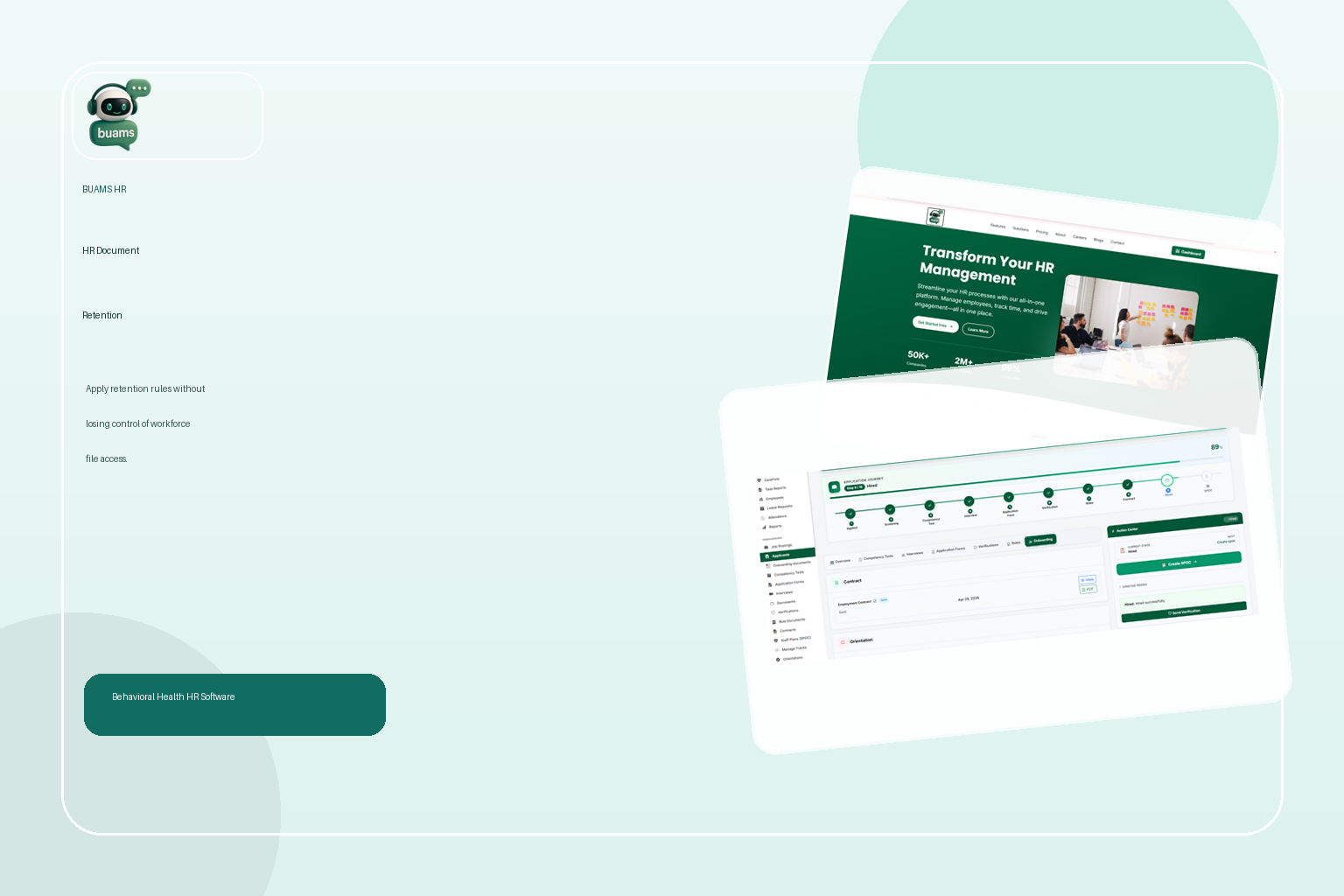
HR document retention software helps organizations manage that lifecycle with more control. Instead of treating retention like a box of archived files or a spreadsheet reminder, providers can connect document organization, employee status, access controls, and review workflows inside a more consistent process. For behavioral health organizations that operate across multiple programs or sites, that structure reduces the risk of missing records, keeping files longer than necessary without oversight, or struggling to respond when audits, claims, or internal reviews require fast retrieval.
Key Takeaways
What Is HR Document Retention Software?
HR document retention software is used to organize employee records according to how long they should be kept, who should be able to access them, and where they belong during each phase of the employment lifecycle. In practice, the value is not just storing a file in one place. The value comes from maintaining a structured record environment where onboarding forms, compliance documents, policy acknowledgments, credential evidence, and separation records can be located and managed according to internal rules and regulatory expectations.
For behavioral health providers, retention work is especially important because HR records often support broader operational needs. Organizations may need fast access to hiring documentation, role histories, compliance evidence, training records, accommodation paperwork, or separation materials during accreditation reviews, payer oversight, legal review, or internal investigations. When documents are scattered across disconnected systems, retention becomes inconsistent and retrieval becomes stressful.
Why Retention Discipline Matters in Behavioral Health HR
Behavioral health organizations rarely manage a simple workforce environment. Teams may include clinicians, direct care staff, case managers, supervisors, support staff, and mobile or community-based workers across multiple locations. Each employee can generate a large record trail over time, and not every document should be handled the same way. Some files need to remain readily available while an employee is active. Others may need restricted access, separate handling after separation, or closer monitoring because they relate to compliance, employment actions, or health information.
Without a clear retention process, HR teams tend to default to two risky patterns. The first is over-retention without structure, where everything stays everywhere because nobody wants to delete the wrong file. The second is fragmented cleanup, where records are moved or removed inconsistently by different people. Both patterns create problems. Over-retention makes it harder to locate the right document quickly, increases privacy and access risk, and leaves organizations with cluttered employee files. Fragmented cleanup makes it harder to prove consistency and can create gaps when documentation is needed later.
Retention discipline also supports confidence during leadership changes, program expansion, or audit activity. If the organization can show that employee records are maintained in a structured system with consistent file handling, HR work becomes easier to defend and easier to scale.
Where Manual Retention Processes Break Down
Many providers have retention intentions but not a durable workflow. A written policy may exist, but daily document handling still depends on individual memory, local folders, and occasional cleanup projects. That gap between policy and practice is where risk builds.
These issues are common because retention work usually happens in the background. It does not always feel urgent until an organization needs a file immediately, cannot confirm whether it should still exist, or realizes access has become too broad. Good systems reduce that uncertainty before it becomes a problem.
What to Look For in HR Document Retention Software
The best HR document retention software for behavioral health providers should make file organization more consistent without turning routine HR work into a manual records project.
Centralized employee file organization
Retention is much easier when documents live in one structured employee record instead of scattered paper folders and shared drives. Centralization gives HR teams a more dependable foundation for managing what belongs where.
Connection to employee status changes
Retention stages should not be separate from the rest of the workforce lifecycle. When an employee transfers, goes on leave, changes role, or separates, those events should inform how HR reviews the file and manages document access moving forward.
Role-based access discipline
Not every workforce document should be visible to every manager or administrator. A strong system helps organizations control access to sensitive materials while still allowing authorized users to retrieve what they need for legitimate HR work.
Reliable retrieval during audits and reviews
Behavioral health providers benefit from software that makes it easier to retrieve complete records without piecing them together from several sources. Fast access matters during accreditation preparation, internal reviews, payer requests, and employment-related inquiries.
Consistent record maintenance workflows
Retention works better when HR can review, organize, and maintain files inside repeatable processes. That includes clear ownership for document uploads, updates, naming standards, and file completeness checks.
Best Practices for Managing HR Retention Workflows
First, define document categories clearly enough that HR staff know how to file records consistently. If everything is saved under generic labels, retention oversight becomes harder because the organization cannot quickly distinguish between onboarding paperwork, compliance evidence, employee relations documents, and general correspondence.
Second, connect retention review to lifecycle events instead of treating it as a once-a-year cleanup task. Hire date, role change, credential change, leave events, and separation are all practical checkpoints for confirming that records are complete, stored in the right place, and handled under the right level of access.
Third, reduce dependence on local copies and email attachments as record repositories. A centralized source of truth makes retention easier because teams know which file is official and where it should live. That matters when supervisors, HR, compliance staff, and leadership may all touch the same employee documentation over time.
Fourth, make file retrieval part of the retention strategy. Retention is not only about keeping or removing records. It is also about making sure the organization can find the right document quickly when it still has a legitimate reason to use it. A well-organized system supports both control and usability.
How BUAMS HR Helps
BUAMS HR helps behavioral health providers manage employee records in a more centralized and organized system. Instead of relying on disconnected folders, manual naming habits, and scattered archives, teams can maintain workforce documents in one place with better visibility across the employee lifecycle.
That makes it easier to support consistent file organization, status-based record management, and cleaner retrieval when HR needs to review onboarding materials, compliance documentation, acknowledgments, or separation-related records. For organizations with multiple programs, locations, or service lines, BUAMS HR helps reduce administrative sprawl and gives leaders a more reliable foundation for handling employee files over time.
By improving how records are organized and maintained, BUAMS HR supports the day-to-day discipline behind stronger retention practices. HR teams can spend less time hunting for documents and more time keeping records complete, accessible to the right people, and better aligned with internal policy.
Final Thoughts
HR document retention software gives behavioral health providers a more practical way to manage employee records through every stage of the workforce lifecycle. The goal is not simply to store more files. The goal is to maintain cleaner structure, better access control, and more dependable retrieval so retention rules can be applied with confidence.
For organizations that want less guesswork in employee file management, BUAMS HR provides a stronger operational foundation. A centralized record system helps providers keep important workforce documentation organized, easier to review, and more manageable as retention responsibilities grow.